Summary:
You’ve already made the decision — the stump needs to go. Now you’re trying to figure out what “stump grinding” actually means in practice, whether it’s the right approach for your situation, and what a legitimate professional service is supposed to include. That’s a reasonable place to be, and it’s a question more Nassau County, NY homeowners should be asking before they get a quote.
This isn’t a pitch. It’s a straightforward breakdown of what the process involves, what separates a thorough job from a cut-rate one, and what you should know before anyone fires up a machine in your yard.
The Complete Stump Grinder Service Process, From Start to Finish
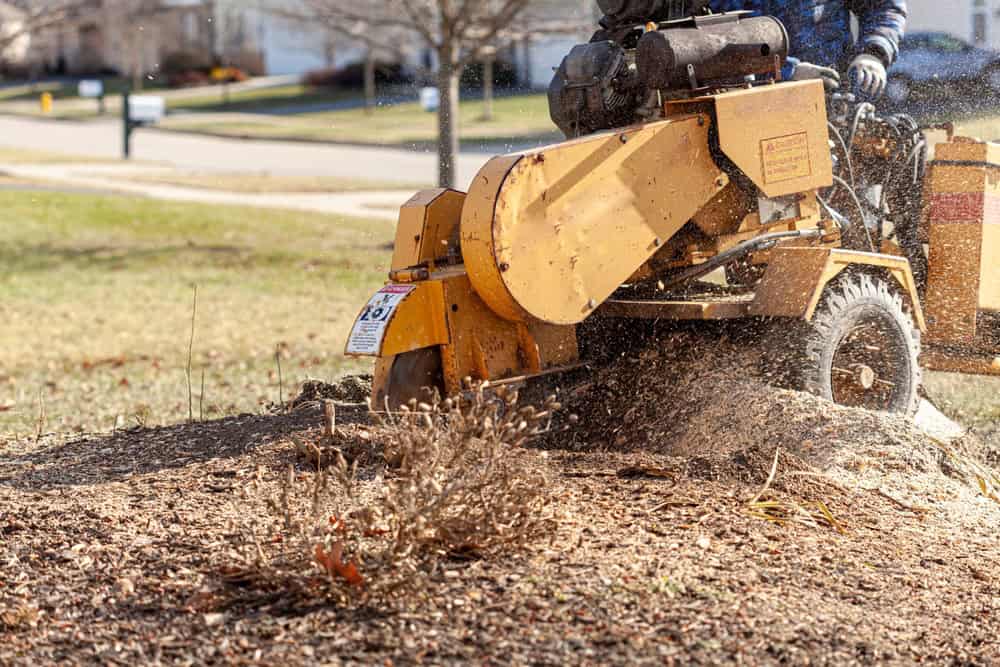
Stump grinding is exactly what it sounds like: a machine equipped with a rotating cutting disc grinds the stump down below ground level, turning the wood into chips. The disc uses carbide-tipped teeth and is controlled hydraulically, which lets the operator move it side to side and up and down to work through the entire stump — not just the top.
What most homeowners don’t realize is how much happens before and after that grinding. A professional stump grinding service isn’t just showing up with a machine and running it until the stump disappears. There’s a process, and the quality of that process is what separates a job done right from one that causes problems later.
Site Assessment and Utility Marking Before Any Work Begins
The first thing we do — before any equipment comes off the truck — is assess the site. That means looking at the stump’s diameter, checking for surface roots that extend beyond the visible base, identifying what’s nearby (fences, foundations, irrigation lines, garden beds), and confirming access to the stump.
In Nassau County, NY, that last point matters more than people expect. Many homes here have narrow side yards, low gates, or mature landscaping that limits what equipment can get through. We size up those constraints before we start, not after.
The other step that doesn’t get talked about enough is utility marking. Nassau County’s residential areas sit on top of decades of layered infrastructure — gas lines, water mains, cable conduit, irrigation systems. Before any grinding begins, we coordinate with NY 811 (Dig Safely New York) to have underground lines marked. This isn’t optional. It’s a legal requirement and a basic safety measure. If a company skips this step, that’s a red flag worth taking seriously.
Once the site is assessed and utilities are marked, we clear and protect the area around the stump. That means moving any debris, covering nearby plantings if needed, and making sure we know where the grinding chips are going to go. These aren’t complicated steps, but they’re the difference between a clean job and a messy one.
Grinding Depth and What It Means for Your Yard
This is one of the most important questions to ask before you agree to anything, and most homeowners don’t think to ask it. Our standard professional grinding goes to about four to six inches below grade — meaning below the surface of your lawn. That’s deep enough for most situations: the area can be filled, the stump won’t regrow, and the yard can be returned to normal use.
If you’re planning to replant grass or lay sod over the area, four to six inches is typically sufficient. But if you want to plant a new tree in the same spot, or if a contractor is doing work nearby that requires a clean subgrade, you’ll want to go deeper — eight to fifteen inches is achievable with our commercial-grade equipment. The key is knowing what you want the space to be used for before we arrive, so the depth is right for your situation.
What you don’t want is a crew that grinds only to grade level — flush with the lawn — and calls it done. That’s not a complete job. The stump will continue to decompose underground, which can create a soft spot or a slight depression in your lawn over time. A few extra inches of depth solves that problem entirely.
After grinding, we clean up the area thoroughly. The process produces a significant amount of wood chips, and what happens to those chips should be discussed upfront. Most homeowners have two options: the chips can be spread as mulch around garden beds (they’re actually useful organic material), or they can be hauled away. Either way, it shouldn’t be left as an unsorted pile in the middle of your yard without a conversation. If backfilling with topsoil and reseeding is something you want, that’s worth asking about before the job starts — not after.
Tree Stump Grinder Service vs. Full Extraction: Choosing the Right Approach
Most homeowners assume these two things are interchangeable. They’re not, and choosing the wrong approach for your situation can mean unnecessary expense, a longer disruption to your yard, or — in some cases — a job that doesn’t actually solve the problem.
Grinding reduces the stump to below ground level. The root system stays in place and decomposes naturally over time. Full extraction physically removes the stump and the root ball entirely, which requires heavy excavation equipment, leaves a much larger hole, and typically costs considerably more. For the overwhelming majority of residential Nassau County jobs, grinding is the right call.
When Stump Grinding Is the Right Choice
Grinding works well for most standard situations: you had a tree removed, there’s a stump left behind, and you want the area cleared so you can mow freely, plant something new, or just stop looking at it. The process is relatively fast — most residential stumps can be ground in a few hours — and the disruption to the surrounding lawn is minimal compared to excavation.
It’s also the right choice when the stump is close to other plantings or structures that you don’t want disturbed. Because grinding is precise and controlled, our operators can work around nearby roots, garden beds, or hardscape without tearing up the surrounding area. That’s a real advantage in Nassau County, NY neighborhoods where yards are tightly landscaped and there isn’t a lot of room for collateral damage.
One thing worth knowing: grinding doesn’t kill every root. The deeper root system stays underground and will decompose on its own over the next few years. For most tree species, that’s fine — the roots aren’t going anywhere, and they’re not going to cause problems as they break down. But for certain species that are known to resprout aggressively from their roots — Norway maple is a common one in Nassau County — it’s worth asking about stump treatment options that prevent regrowth before the grinding is done.
When Full Extraction Makes More Sense
Full extraction makes sense in a narrower set of circumstances. If you want to plant a large tree in exactly the same location, the remaining root mass from grinding can interfere with the new tree’s root development — extraction gives you a genuinely clean start.
Similarly, if the stump is very close to a foundation or a retaining wall and there’s concern about root pressure on those structures, extraction may be the more thorough solution. It’s also worth considering extraction if the stump is part of a larger construction or landscaping project that requires a clean, consistent subgrade — a patio installation, for example, or a drainage correction. In those cases, the cost of extraction may be justified by the scope of what’s being built around it.
For everything else — the standard post-removal stump sitting in a suburban Nassau County, NY backyard — extraction is more than the situation calls for. It’s more expensive, more disruptive, and the recovery time for your lawn is longer. We’ll tell you this honestly rather than upsell you on a more intensive job you don’t need.
This is exactly why an on-site assessment before any work begins is worth more than a phone quote. The stump’s size, species, location relative to your home and utilities, and your plans for the space all factor into which approach is actually right for you. A crew that gives you a firm recommendation without seeing the site is guessing.
Getting Stump Grinding Right in Nassau County, NY
Most of the frustration homeowners run into with stump grinding comes down to one thing: not knowing what to expect or what to ask before the job starts. Depth, debris cleanup, utility marking, backfill options — these aren’t fine print. They’re the difference between a job that leaves your yard looking right and one that leaves you with questions afterward.
Nassau County, NY’s older neighborhoods, mature trees, and dense underground infrastructure mean there’s more to think through here than in a lot of other markets. The stumps tend to be large-diameter hardwood, the lots are tight, and the utilities are everywhere. That’s not a reason to put it off — it’s a reason to work with a crew that’s done this specific kind of work, in this area, for a long time.
If you’re ready to move forward — or just want someone to look at the stump and give you a straight answer — we offer free on-site estimates with no obligation and no hidden fees. Reach out by phone or text at 516-903-0730 and we’ll come take a look.