Summary:
You’ve got trees to remove, stumps to deal with, or a section of your yard that’s completely overgrown — and now you’re staring at three different service names wondering if they’re the same thing or completely different. They’re not the same. Forestry mulching, stump grinding, and traditional land clearing each solve a different problem, use different equipment, and leave your property in a different state. Choosing the wrong one doesn’t just waste money — it can actually create more work down the line. Here’s a plain-language breakdown of all three, including why each one matters differently on Nassau County properties.
What Is Forestry Mulching and How Does It Work?
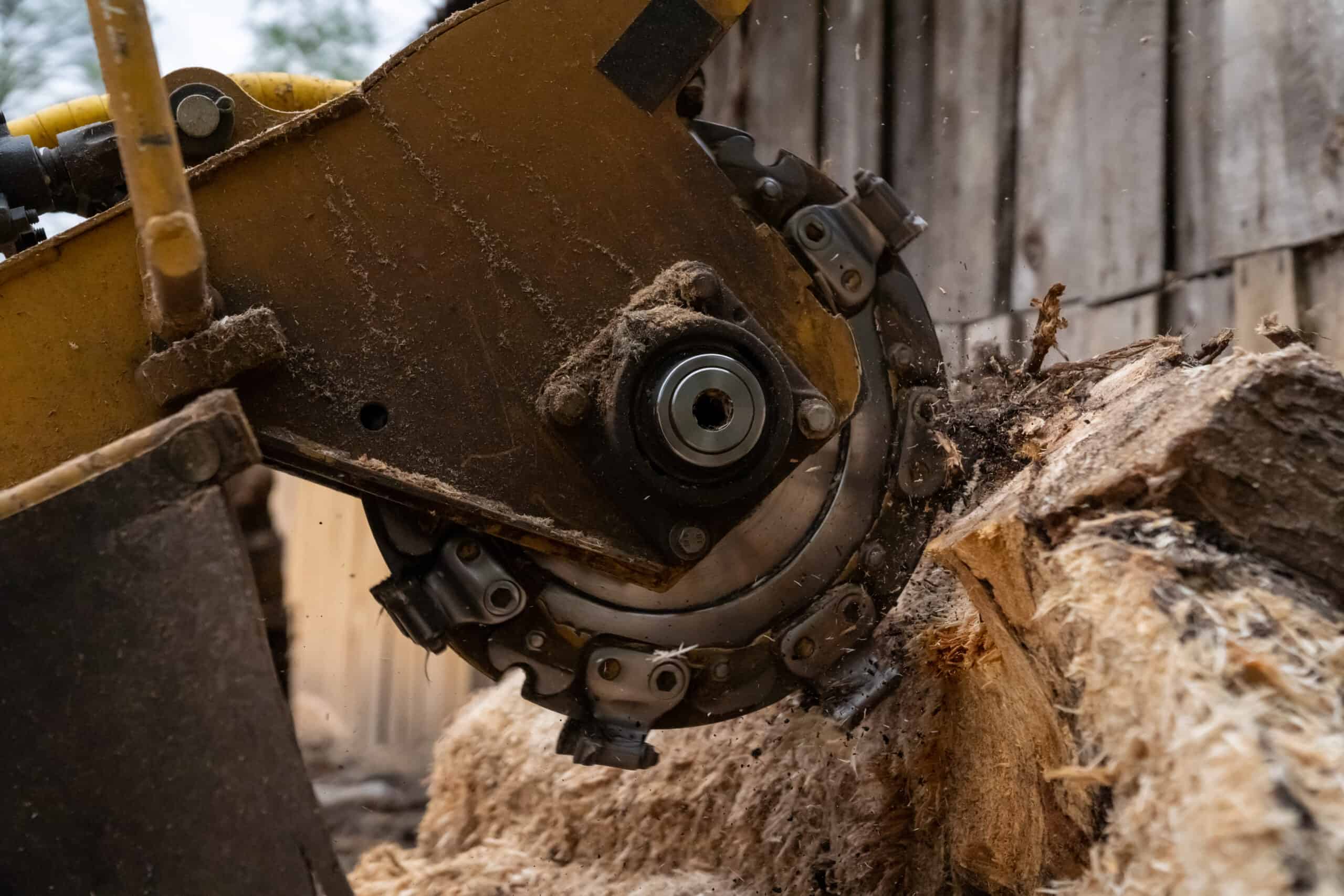
Forestry mulching is a land clearing method where a single machine — fitted with a rotating drum of hardened steel teeth — cuts, grinds, and shreds trees, brush, and stumps simultaneously. The material doesn’t get hauled away. It gets processed on the spot and left behind as a layer of mulch that covers the ground where the vegetation used to be.
That’s the part most people don’t expect. There’s no debris pile, no dump truck, no separate crew to haul anything off. One machine does the whole job in one pass. On a standard residential lot in Nassau County, that changes the math on both cost and time pretty significantly.
Why Forestry Mulching Works Well on Nassau County's Suburban Lots
Nassau County isn’t rural. Most residential lots here are tight — often under a quarter-acre — with neighbors close by, fences along the perimeter, and underground utilities that don’t always show up on a map. Traditional clearing equipment, the kind that involves bulldozers and excavators, needs room to operate. On a typical lot in Massapequa, Freeport, or Valley Stream, that room often doesn’t exist without risking damage to a fence line, a neighboring structure, or a sprinkler system you forgot was there.
Forestry mulching uses a tracked or wheeled skid-steer-style machine that’s compact enough to navigate around what you want to keep. If there’s a mature oak you want to preserve while clearing the overgrown brush around it, we can work around it. That level of precision just isn’t possible when you’re pushing everything over with a dozer.
There’s also the disposal cost factor, which is a real issue on Long Island specifically. Hauling stumps and root balls off the island adds significant cost to any traditional clearing project — that expense disappears entirely with forestry mulching because nothing leaves the property. The mulch layer that’s left behind isn’t an eyesore, either. It decomposes naturally over time, suppresses weed regrowth, and helps stabilize the soil — which matters especially on the South Shore, where sandy soil erodes quickly once ground cover is removed.
Forestry mulching also provides permanent clearing. It’s not like brush hogging, which cuts vegetation down to the ground but doesn’t stop it from growing back. With forestry mulching, the root structure is disrupted and regrowth is suppressed. For Nassau County homeowners dealing with invasive species like porcelain berry, Japanese knotweed, or overgrown privet, that distinction is significant.
Does Forestry Mulching Remove Stumps Completely?
This is the question we hear most often, and the honest answer is: mostly, but not always to the depth you might need.
A forestry mulching machine grinds stumps down to near ground level. For most residential uses — clearing space for a lawn, a garden, or general yard cleanup — that’s more than sufficient. The stump material gets shredded and incorporated into the mulch layer, and within a growing season or two, what’s left has largely decomposed.
But here’s where it matters: if you’re planning any kind of construction after the clearing — a pool, a garage addition, a patio, grading for drainage — near-grade isn’t the same as below-grade. A dedicated stump grinder reaches 8 to 12 inches below the surface. That depth is what contractors and landscapers need before they can grade, pour, or build without hitting buried wood that shifts and voids as it rots.
This is exactly why some projects need both services in sequence. Forestry mulching handles the wide-area clearing efficiently. Then targeted stump grinding addresses the specific spots where depth matters. If a company tells you forestry mulching alone is enough for a construction-prep project without asking what you’re building, that’s worth questioning.
Stump Grinding vs. Traditional Land Clearing: When Each One Makes Sense
Stump grinding and traditional land clearing are not interchangeable, even though they sometimes get lumped together in quotes and conversations. Stump grinding is a targeted, precise service — you use it when you have specific stumps to remove and you need them gone below grade. Traditional land clearing is a broad-scope operation — you use it when a large area needs to be completely stripped and prepared for construction or major development.
Understanding the difference saves you from paying for more than you need, or from choosing a method that leaves you with a problem the next contractor has to fix.
When Is Stump Grinding the Right Call for Nassau County Properties?
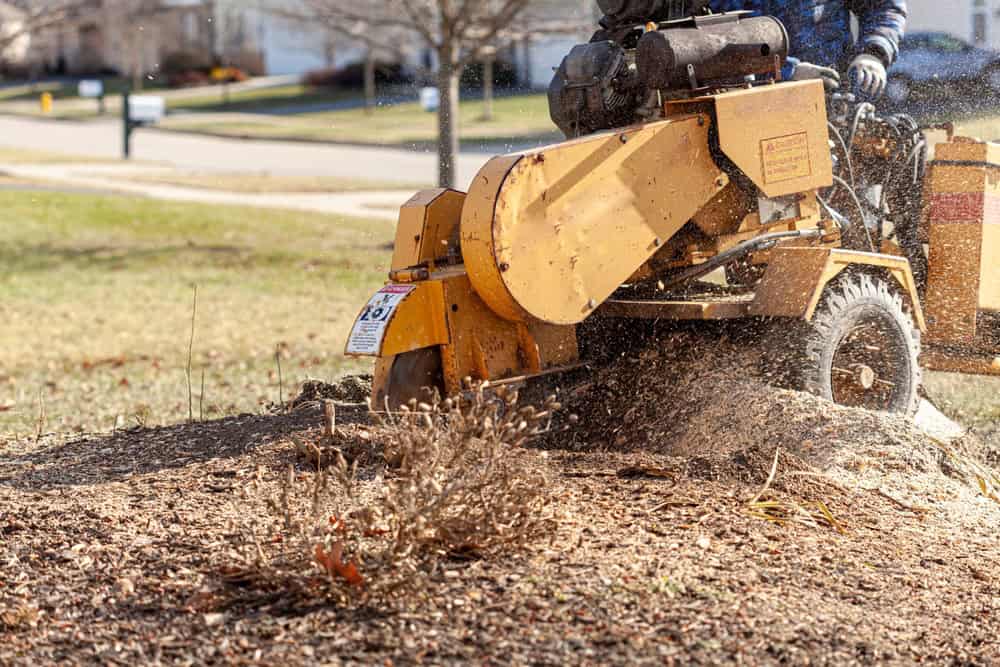
Stump grinding is the right call when you have one, two, or a handful of stumps left behind from a previous tree removal — and you want them gone cleanly. It’s precise work. The grinder sits directly over the stump and works it down 8 to 12 inches below the surface, leaving a hole that gets backfilled with the resulting wood chips. The area is ready to sod, plant, or build over.
In Nassau County’s older housing stock — neighborhoods like Levittown, Hicksville, and Garden City that were developed in the 1940s and ’50s — it’s common to buy a property and discover stumps from trees that were removed years ago by a previous owner. They’re partially decomposed, sometimes hidden by grass, and they become a problem the moment you try to do anything with that section of the yard. Stump grinding is the clean, efficient solution for exactly that scenario.
It’s also the right follow-up service after a tree removal. When we take down a tree, the stump stays until you decide what to do with it. If you’re planning to replant, build a raised bed, or simply want a flat, usable lawn, grinding it down below grade is the move. The process is faster than most people expect — a standard residential stump takes less than an hour in most cases — and the result is immediate. You’re not waiting for something to decompose. It’s gone.
One thing stump grinding doesn’t do: it doesn’t clear surrounding brush, process debris, or handle multiple trees. If you have more than a few stumps scattered across a larger area with significant overgrowth, that’s when forestry mulching or a combination approach becomes more efficient.
What Does Traditional Land Clearing Actually Involve — and When Do You Need It?
Traditional land clearing is the heavy-equipment approach — excavators, bulldozers, and haul trucks working together to strip a site completely. Trees come down, stumps get pulled from the ground root ball and all, and everything gets loaded and removed from the property. What you’re left with is bare soil, ready for grading and construction.
For large-scale commercial development or projects where the site specification requires complete topsoil removal and precise grading, traditional clearing is the appropriate method. It’s thorough in a way that forestry mulching isn’t designed to be. But it comes with real cost implications, especially on Long Island. Hauling stumps and root balls off the island adds substantial expense to any traditional clearing project — costs that don’t exist with forestry mulching because nothing leaves the site.
For most Nassau County residential projects, traditional clearing is overkill. The lots are smaller, the neighbors are closer, and the scope of most residential clearing jobs — overgrown sections of a backyard, storm-damaged areas, lots being prepped for pools or additions — doesn’t require stripping the site to bare earth. That’s where forestry mulching steps in as the more practical and often more cost-effective option.
There are scenarios where a combination of methods is the most sensible approach. A large wooded section might benefit from forestry mulching to handle the bulk of the vegetation, followed by targeted stump grinding on specific spots where construction depth is required. We’ve worked on Nassau County properties — particularly in the more heavily wooded North Shore communities like Great Neck, NY and Roslyn, NY — where the right answer was a phased approach rather than a single method. The goal is always to match the method to the project, not to fit the project into whatever one method can do.
Which Land Clearing Method Is Right for Your Nassau County Property?
The short version: forestry mulching is the most efficient choice for clearing larger overgrown areas on residential lots, especially where equipment access is tight and you want to avoid hauling costs. Stump grinding is the right tool when you need specific stumps removed to a depth that construction or landscaping requires. Traditional land clearing makes sense for large-scale development where full site stripping is the specification.
Most Nassau County homeowners don’t need all three — but some projects genuinely benefit from two methods used in sequence. The only way to know for certain is to have someone look at the actual property, understand what comes next for the site, and give you an honest assessment of which approach fits.
We offer free on-site evaluations before any quote — no phone guesswork, no hidden fees once the work starts. Long Island Best Tree Service, Inc. has been working on Nassau County properties for over 20 years. If you’re trying to figure out what your property actually needs, reach out and we’ll come take a look.