Summary:
You already know you want the stump gone. What you probably don’t know yet is which method is actually right for your specific situation — and that distinction matters more than most people realize. The wrong choice can leave roots interfering with a future patio, cost you more than the job needs to, or drag out a process that should take a single afternoon. We’ve been handling stump removal across Nassau County for over 20 years, and the question we hear most isn’t “can you remove it?” It’s “what’s the best way to do it?” Here’s the honest answer.
Three Stump Removal Methods: What Your Options Actually Are
There are three realistic ways to deal with a tree stump: grind it down, dig it out completely, or apply chemicals to accelerate decomposition. Each one has a legitimate use case, and none of them is universally the best choice. The right method depends on what the stump looks like, where it’s sitting, what you plan to do with that space afterward, and how quickly you need it handled.
Understanding the difference upfront saves you from paying for more than you need — or worse, choosing the faster option only to find out later it wasn’t right for your plans.
How Stump Grinding Works — and What It Leaves Behind
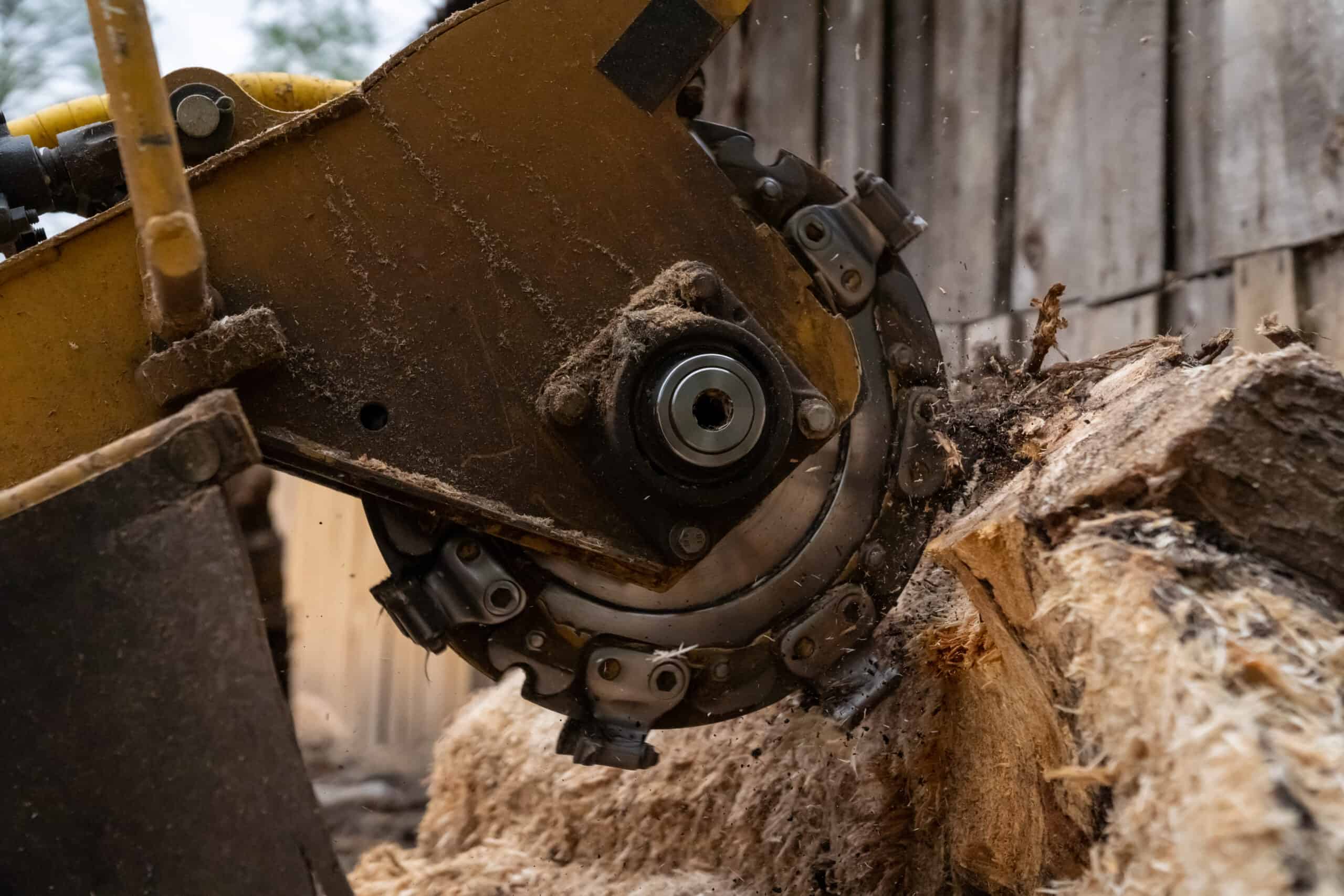
Stump grinding is the most common professional method, and for most Nassau County homeowners, it’s the right one. A stump grinder uses a rotating cutting wheel with sharp teeth to chip the stump down to ground level — or just below it. The machine works through the wood quickly, turning it into chips and sawdust as it goes. The whole process can typically be completed in a few hours, and the area is ready to use the same day.
Here’s what most people don’t realize going in: grinding removes the visible stump and the surface-level roots, but the deeper root system stays in the ground. For the majority of residential situations, that’s completely fine. The roots are no longer connected to a living tree, so they won’t keep growing. They’ll decompose on their own over time, typically within a few years depending on the species and soil conditions.
Where this matters is if you’re planning to pour concrete, install a fence post, build an addition, or plant a new large tree in the same spot. In those cases, the remaining root mass underground could interfere with your plans, and full extraction may be the better call. But for homeowners who just want a clean yard, a flat surface to mow over, and no more tripping hazard near the driveway — grinding does exactly what it needs to do, efficiently and affordably.
The wood chips produced during grinding can either be hauled away or left on-site to use as mulch. That’s your call. We remove all debris and leave the area clean, so you’re not dealing with a pile of chips after we’re gone unless you want to keep them.
Full Stump Extraction vs. Grinding: When Digging Out the Root Ball Makes Sense
Full stump extraction means pulling the entire root ball out of the ground, not just grinding the visible portion down. It’s a more invasive process that requires heavier equipment, more labor, and leaves a larger hole in your yard that needs to be filled. It also costs more than grinding in most cases.
So why would you choose it? There are specific situations where full extraction is genuinely the right answer. If the stump is located directly where you’re planning to pour a concrete slab, lay a foundation, or run underground drainage, leaving roots in the ground isn’t an option. The same applies to stumps positioned very close to a home’s foundation or along a driveway where root decomposition over time could cause shifting or cracking.
In Nassau County, where properties are close together and lots are often tight, we see this come up regularly with stumps near shared driveways, detached garages, and older concrete sidewalks. The homes here were largely built in the 1940s through 1960s, and the trees that went in around the same time have had decades to develop deep, wide root systems. When those trees come down — whether from storm damage, disease, or age — the stumps they leave behind aren’t small.
Full extraction is also worth considering if the stump is from a tree species known for aggressive root regrowth, though this is less common once the tree itself is gone. If you’re not planning any construction or deep planting in that area, grinding is almost always the faster, less disruptive, and more cost-effective choice. If you are, it’s worth having someone look at the job in person before deciding.
Chemical Stump Treatment vs. Grinding: Why the Slow Method Rarely Works in Nassau County
Chemical stump removal is the option that looks appealing in the hardware store aisle and tends to disappoint in the yard. The process involves drilling holes into the stump, filling them with a potassium nitrate-based product, and waiting. The chemical softens the wood over roughly four to six weeks, after which some products recommend burning the softened stump using an accelerant. It’s slow, it requires multiple steps, and the results are rarely as complete as grinding.
For a homeowner with a small, isolated stump and no timeline pressure, chemical treatment is technically an option. For most Nassau County yards — where stumps are often large hardwoods, lots are tight, and neighbors are close — it’s rarely practical.
Why Chemical Removal Doesn't Work Well in Nassau County's Dense Neighborhoods
Nassau County’s suburban density creates a specific set of conditions that make chemical stump treatment a poor fit in most cases. The county is one of the most densely populated in the country, and that shows up in how properties are laid out — close lot lines, neighbors within a few feet, and underground utilities running through nearly every yard. Gas lines, electric, cable, water, and sewer infrastructure are packed tightly beneath the surface throughout communities like Hempstead, Levittown, Mineola, and Valley Stream.
Chemical treatment that involves burning a softened stump is genuinely risky in this environment. Even setting fire risk aside, the four-to-six-week wait time means the stump stays in your yard for over a month before anything meaningful happens. If you’re dealing with the aftermath of a storm — which is a recurring reality here, given Nassau County’s exposure to nor’easters and summer storm systems — you want the stump gone, not softening slowly in the corner of the yard.
There’s also the matter of what chemical treatment doesn’t do: it doesn’t remove the root system, doesn’t leave a clean surface, and doesn’t give you any real control over the timeline. What you’re left with after the process is a partially decomposed stump that still needs to be broken apart and cleared away. That’s more work, not less.
For homeowners who’ve already tried a chemical product and found it underwhelming, you’re not alone. It’s one of the most common things we hear before someone calls us. The grinding process handles in a few hours what chemical treatment struggles to accomplish in weeks.
Root Removal After Stump Grinding: What Stays in the Ground and Why It Matters
After stump grinding, the surface stump and visible roots are gone, but the deeper root system remains in the ground. The roots are dead — they’re no longer connected to a living tree and won’t continue to grow — but they don’t disappear overnight. They decompose gradually over time, which for most homeowners is a non-issue.
Where it becomes an issue is when future plans involve the same ground. If you’re planting grass over the area, filling in the hole with topsoil and seed works fine. If you want to plant a shrub or small tree nearby, the decomposing roots won’t interfere. But if you’re planning to install a fence line directly through that area, pour a concrete pad, or do any kind of excavation work, the remaining root mass is worth factoring in before you start.
In Nassau County, we see this come up most often with homeowners who are preparing to sell. The real estate market here moves, and curb appeal matters. A freshly ground stump area, filled and seeded, looks dramatically better than a rotting stump — and it doesn’t raise flags during a home inspection the way a large, deteriorating stump near a foundation can.
We also see it after storms. When a large oak or maple comes down across a property in Garden City or Great Neck, the stump that’s left behind is often substantial — wide diameter, deep roots, close to the house or driveway. In those cases, an on-site look before quoting is the only honest way to recommend the right approach. The size, species, location, and your plans for the space all factor into whether grinding covers it or whether extraction is worth the added cost.
Which Stump Removal Method Is Right for Your Nassau County Yard?
For most Nassau County homeowners, stump grinding is the right call. It’s fast, it’s effective, it leaves the yard clean, and it handles the vast majority of residential situations without the disruption or cost of full extraction. Chemical treatment works in theory but rarely delivers in practice — especially on the kinds of mature hardwood stumps that are common across Long Island’s older neighborhoods.
Full extraction is worth the extra investment when construction, deep planting, or proximity to a foundation makes leaving roots in the ground a real problem. If you’re not sure which category your situation falls into, an on-site visit is the best way to get a straight answer.
If you’ve got a stump that needs to go — whether it’s one from last week’s storm or one that’s been sitting in the yard for three seasons — Long Island Best Tree Service, Inc. is happy to take a look and give you an honest assessment of what the job actually needs. No hidden fees, no pressure, just a clear recommendation based on your specific situation.