Summary:
Here’s something most tree service companies won’t say out loud: yes, sometimes you can remove a tree yourself. A small, isolated sapling in the middle of an open yard? With the right gear and a careful approach, that’s a reasonable DIY project for a capable homeowner.
But most trees on Nassau County properties aren’t that tree. They’re 50-year-old oaks growing six feet from a fence line. They’re storm-damaged maples leaning toward a roof. They’re curbside trees that three different municipalities have opinions about. So before you rent a chainsaw, it’s worth being honest about what you’re actually dealing with — and what it could cost you if things go sideways.
Can I Remove a Tree Myself? The Framework That Actually Works
The answer depends on five things: tree size, proximity to structures, the direction it naturally leans, the condition of its root system, and whether your municipality requires a permit before you touch it. Run your tree through all five, and the right answer usually becomes obvious.
Size is the most straightforward factor. Most arborists draw the line at trees under fifteen feet that you can work on without ever leaving the ground. Once you need a ladder, the risk profile changes entirely — and on Long Island, where the average residential property is lined with mature trees that have been growing since the postwar housing boom, “under fifteen feet” describes a pretty small slice of the problem trees homeowners are actually dealing with.
Why Tree Lean and Root Condition Change Everything
Here’s what most DIY guides skip over: a tree doesn’t fall where you want it to just because you cut it in the right spot. It falls where its weight, its lean, and its root structure tell it to fall — and those forces don’t always cooperate with your plan.
If a tree leans toward your house, your neighbor’s fence, or a power line, that lean is going to win the argument unless you have the rigging equipment and training to counteract it. Even experienced operators encounter what’s called a “barber chair” — a situation where the trunk splits upward unexpectedly during the cut, sending wood in a direction no one planned for. It’s not a beginner’s mistake. It’s a physics problem that professionals train specifically to manage.
Root condition matters just as much, and it’s a factor that’s easy to underestimate on Long Island. Nassau County’s sandy, salt-affected coastal soils — the same conditions that affect properties from Long Beach to Oyster Bay — can compromise a tree’s root system over time without any visible sign of it above ground. A tree that looks stable from the outside may have far less anchoring than you’d expect. That changes the fall dynamics in ways that are genuinely difficult to predict without a trained eye.
The proximity question is equally unforgiving in Nassau County’s suburban landscape. Lots here are not large. The homes built across Hempstead, Uniondale, and the surrounding towns in the 1950s and 60s were placed close together, and the trees that have grown up around them reflect that. If there isn’t a clear, unobstructed fall zone that’s at least twice the height of the tree, you don’t have a DIY situation — you have a professional situation.
Power lines add another layer entirely. If a tree is growing into or near overhead utility lines, that’s a PSEG Long Island coordination issue, not a weekend project. Contacting utilities before any work near lines is not optional.
Nassau County Permit Rules: The $10,000 Detail Nobody Mentions
This is the part of the DIY conversation that almost never comes up in national tree removal guides — because it’s hyperlocal, and it matters enormously if you own property in Nassau County, NY.
Removing a tree without a required permit here can result in a fine of up to $10,000 per tree. That’s not a hypothetical. It’s the enforcement ceiling under the applicable local codes, and municipalities do issue these fines.
The permit requirements themselves vary depending on exactly where your property sits. The Town of Hempstead regulates trees in the curbside area under Chapter 184 of its town code. The Town of North Hempstead requires a permit for any front-yard tree with a trunk diameter of six inches or more, measured at four and a half feet above the base — a standard measurement called DBH, or diameter at breast height. The Town of Oyster Bay has its own thresholds, and many of the incorporated villages within Nassau County layer additional rules on top of the town-level requirements.
Standard permit applications typically take ten to twenty business days to process. That timeline matters if you’re trying to get a hazardous tree down before nor’easter season hits.
There are exceptions. If a tree is uprooted during a storm and poses an immediate danger, most towns allow emergency removal — but you’re expected to document everything thoroughly and notify the municipality within 48 hours. If a tree is dead or dying, most towns will waive the permit requirement, but only if an ISA-Certified Arborist provides a written certification letter confirming the tree’s condition. Simply believing the tree is dead isn’t sufficient documentation.
The practical takeaway: before you touch any tree on a Nassau County property, find out which municipality governs your lot and what that municipality requires. The permit question alone is often the deciding factor between a DIY project and a call to a professional — especially since a licensed contractor can handle the permit application as part of the job.
How to Remove a Tree: What the Process Actually Involves
For a tree that genuinely passes the framework above — small, isolated, clear fall zone, no permit required, no lean toward anything valuable — the removal process follows a logical sequence. Understanding it helps you make an informed decision about whether you want to take it on.
You’re planning a controlled fall, executing precise cuts in the right order, and then dealing with everything that’s left behind. Each of those steps has more complexity than it sounds, and the equipment required to do them safely adds up faster than most homeowners expect.
Tree Felling Basics: The Notch, the Back Cut, and Why Sequence Matters
Tree felling is the act of cutting a standing tree so that it falls in a controlled direction. The technique that makes controlled felling possible is a two-cut system: a notch cut on the side facing the intended fall direction, followed by a back cut on the opposite side.
The notch cut creates a wedge-shaped opening that guides the fall. The back cut, made slightly above the bottom of the notch, releases the tree’s weight while leaving a thin section of uncut wood — called the hinge — that acts as a pivot point and controls the direction of the fall. Get the hinge right and the tree goes where you want it. Get it wrong, or misjudge the tree’s natural lean, and you lose control of something that may weigh several tons.
Before any cut is made, you need to identify your escape routes — two clear paths leading away from the fall zone at roughly 45-degree angles from the back of the tree. When the tree starts moving, you move immediately. This isn’t optional and it isn’t overcautious; it’s the standard practice that professional arborists follow on every single job.
You also need to clear the fall zone before you start. That means removing anything within a radius of at least twice the tree’s height — furniture, vehicles, fencing, anything. On a typical Nassau County property, that radius may overlap with a neighbor’s yard, a driveway, or a structure, which is precisely why many trees here don’t have a viable fall zone to begin with.
The equipment side of this is worth being honest about. Safe chainsaw operation requires a chainsaw, chainsaw chaps, steel-toed boots, a hard hat, eye protection, hearing protection, and gloves. Chainsaw rental alone runs $70–$90 per day on average. Add safety gear at $185–$305 if you don’t already own it, wood chipper rental if you want to deal with the branches, and debris disposal fees, and a medium tree DIY removal can realistically cost $350–$700 or more — before accounting for a full weekend of physical labor.
What Happens After the Tree Is Down
Cutting the tree down is the part homeowners picture. What comes after it is the part that often surprises them.
Once the tree is on the ground, you’re looking at a significant volume of wood and debris that needs to be dealt with. Branches need to be cut into manageable sections. The trunk needs to be cut into rounds or hauled out whole. If you rented a wood chipper, the brush can be chipped on-site — but operating a wood chipper safely is its own skill set, and chipper-related injuries are among the more serious in the DIY home improvement category.
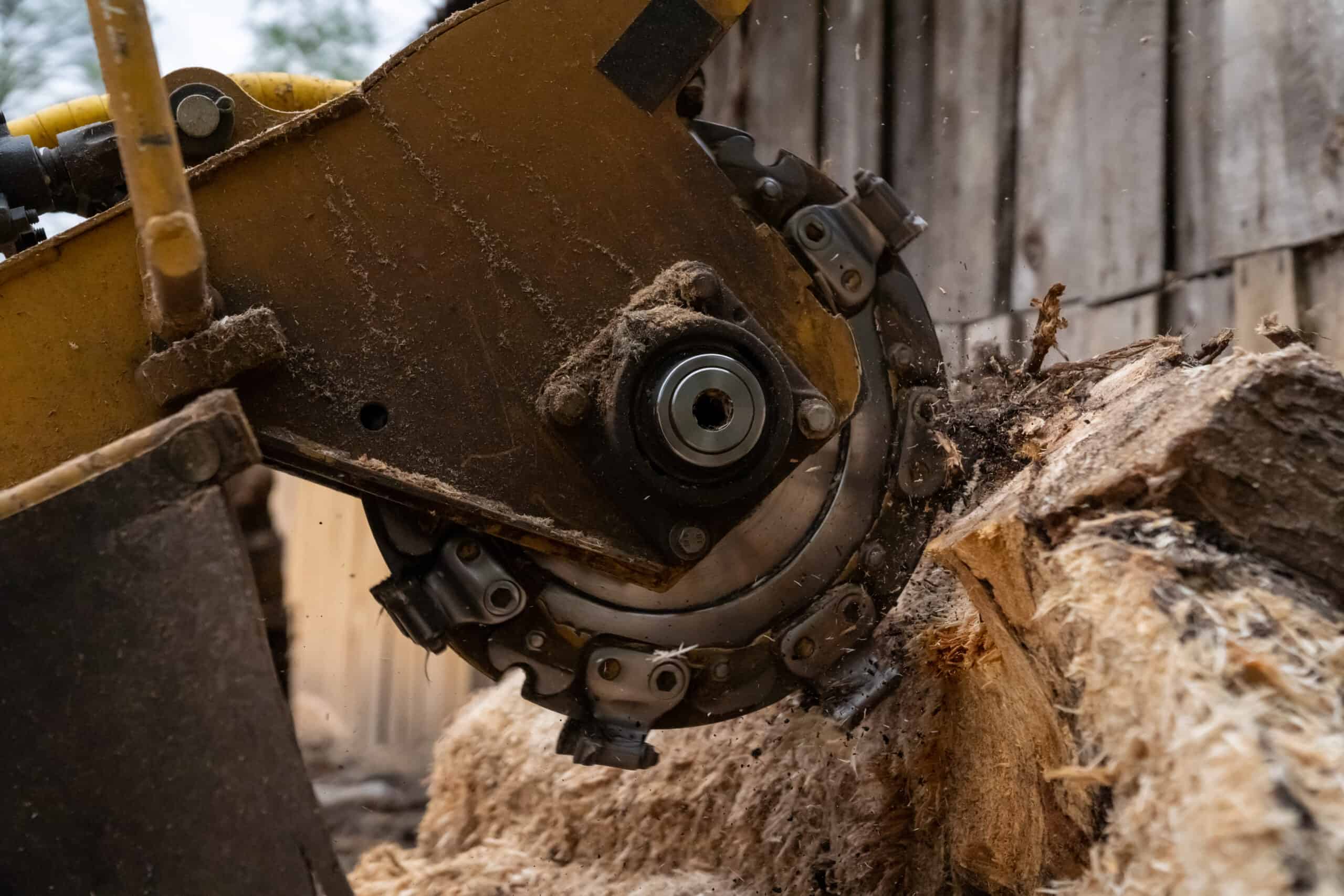
Then there’s the stump. Cutting a tree down leaves a stump and a root system that don’t go away on their own. Stump grinding requires a dedicated machine — a stump grinder — that most homeowners will need to rent separately. The roots themselves can extend well beyond the stump’s visible footprint, and in Nassau County’s sandy soils, surface roots are common and can interfere with lawn care, landscaping, and hardscaping for years if not properly addressed.
Hauling the debris off your property adds another layer of cost and logistics. Dump fees, truck rental, or a junk removal service all carry their own price tags. By the time you’ve honestly added up equipment, gear, disposal, and time, the math on DIY often looks different than it did at the start.
A full-service professional job — one that includes the removal, stump grinding, and complete cleanup — handles all of it in a single visit. That’s not a sales pitch; it’s just a fair comparison to make before you commit to a weekend-long project with real physical risk attached to it.
When to Call a Professional Tree Service in Nassau County
If your tree is small, isolated, well away from structures and power lines, and your municipality doesn’t require a permit for it — DIY may be a reasonable option. That’s the honest answer.
But if the tree is large, leaning toward anything you care about, growing near overhead lines, or sitting on a Nassau County property where permit rules apply, the calculus shifts quickly. The physical risk is real, the permit consequences are significant, and the equipment cost closes the gap between DIY and professional more than most people expect.
If you’re not sure which side of the line your situation falls on, a free on-site inspection is the lowest-pressure way to find out. We’ve been working in Nassau County for over 20 years, handle permits as part of every job, and can give you a straight answer about what your tree actually requires — no obligation attached.