Summary:
You’ve had a tree taken down — or maybe there’s been a stump sitting in your yard for longer than you’d like to admit. Either way, you’re ready to deal with it. The problem is, the moment you start looking for someone to handle it, the process gets confusing fast. Quotes vary wildly. Companies use terms interchangeably that don’t actually mean the same thing. And it’s not always obvious what’s included until after the job is done.
This guide is written for Nassau County, NY homeowners who want straight answers before they hire anyone. Here’s what you actually need to know.
What Tree and Stump Removal Actually Involves
Most people think of tree removal and stump removal as two separate jobs. Sometimes they are. But when they’re done together — which is often the smarter approach — there’s a specific sequence to how it all unfolds, and understanding that sequence helps you know what you’re paying for and what questions to ask.
The process starts with felling and sectioning the tree. Once the trunk is down, it gets cut into manageable sections and removed from the property. What’s left is the stump and the root system beneath it. From there, you have two options: grind the stump down below grade, or extract it entirely — roots and all. Which one is right for your situation depends on what you plan to do with the space afterward.
Tree Trunk Removal: What Happens Before the Stump Work Starts
This part gets skipped over in most conversations about stump removal, but it matters. Before any grinder touches your yard, the trunk and all major limbs need to be fully removed from the site. That means cutting, sectioning, loading, and hauling — and it’s not always included in a stump-only quote if you’re hiring a second company to finish what a first one started.
If you had a tree taken down and the stump was left behind, you may already be past this stage. But if you’re scheduling a full removal from scratch, make sure you understand exactly where the tree removal ends and the stump work begins. Ask whether trunk removal, debris hauling, and site cleanup are all covered under the same quote — or whether those are separate line items.
This is where a lot of Nassau County, NY homeowners get caught off guard. They hire one company to take the tree down, then realize the stump wasn’t part of the deal. Now they need a second crew, a second visit, and a second invoice. Combining both services in one appointment, with one company, eliminates that gap entirely. It also means the site gets cleaned up in a single pass — no wood chips left behind, no scheduling a follow-up weeks later.
We handle tree trunk removal and stump work together as part of the same job. When you book stump grinding alongside tree removal, we take care of it the same day. You don’t have to coordinate multiple crews or wonder what’s still left to do when we leave.
Root Removal vs. Stump Grinding: Which One Do You Actually Need?
This is the question most homeowners don’t think to ask until after they’ve already hired someone. Stump grinding and root removal are not the same thing, and the difference has real consequences depending on what you’re planning to do with the space.
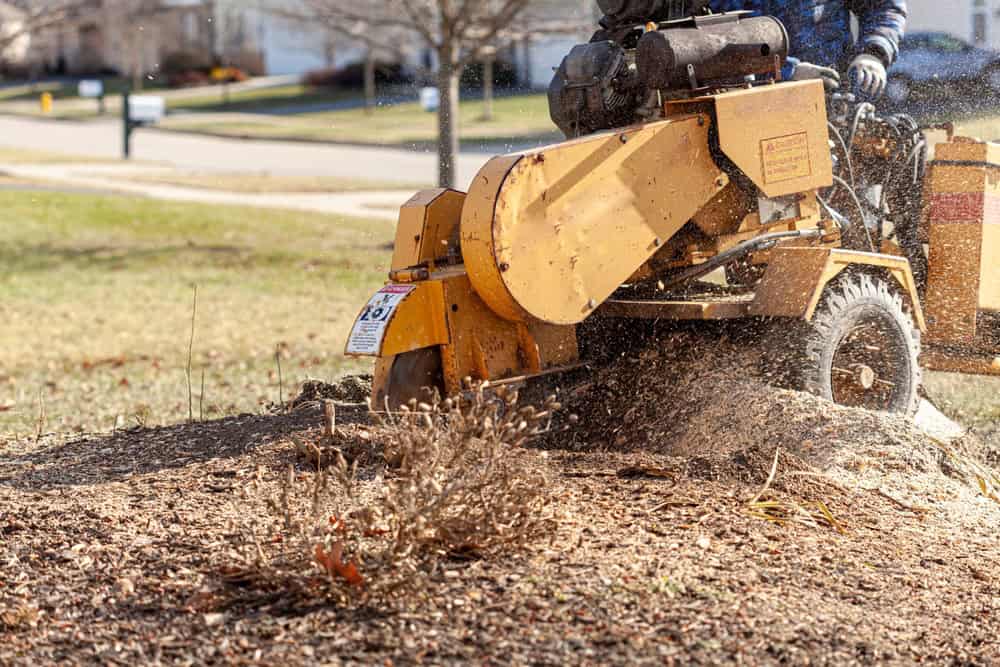
Stump grinding reduces the visible stump to wood chips by cutting it down below ground level — typically six to twelve inches below grade. The root system stays in the ground. Over time, those roots will decay, but that process takes years. In the meantime, you may see mushrooms pop up in the area as the wood breaks down underground. For most residential situations — especially if you’re just reseeding the lawn or planting shrubs — grinding is sufficient, and it’s the more common and cost-effective choice.
Root removal, or full stump extraction, goes further. It pulls the entire root ball out of the ground. This is the right call when you’re planning to build something on that spot — a patio, a shed, an addition — or when you’re replanting a new tree and need clean soil without competing root structure. It’s also worth considering if the root system is close to your foundation, underground plumbing, or a sewer lateral, since decaying roots in those zones can cause problems over time.
In Nassau County, NY specifically, this isn’t a hypothetical concern. The county’s housing stock is largely postwar — many homes were built in the 1950s and 1960s — and the original underground infrastructure runs close to mature tree root systems in ways that newer developments don’t have to contend with. If you have a large, old tree near your house, it’s worth asking whether the roots pose any risk to what’s running beneath your yard before you decide between grinding and full extraction.
The honest answer is that most homeowners don’t need full root removal. But the only way to know for sure is to have someone look at the specific stump, the species, the size, and where it sits relative to your property’s infrastructure. That’s what a proper on-site assessment is for.
What to Look for When Hiring a Professional Tree Stump Removal Company
There are a lot of operators in the Nassau County, NY market. Some are established, fully insured, and equipped for the job. Others are not — and the gap between them isn’t always obvious from a quote alone. Knowing what to look for before you hire protects you from the most common and costly mistakes homeowners make in this category.
The non-negotiables are licensing, insurance, and a written estimate. Everything else — experience, equipment, cleanup — matters too, but those three are the baseline. If a company can’t confirm they’re insured and won’t put the quote in writing, that’s your answer.
Why Insurance Isn't Optional — and What It Means for You as a Nassau County Homeowner
Under New York law, if an unlicensed or uninsured contractor is injured while working on your property, you — the homeowner — can be held personally liable. That’s not a technicality. It’s a real legal exposure that applies regardless of whether you knew the company was uninsured when you hired them.
Nassau County’s dense residential environment makes this even more relevant. Lots are small. Stumps are often close to fences, driveways, neighboring properties, and underground utility lines. Stump grinding involves heavy equipment and rotating cutting teeth that throw debris at high speed. It’s not a low-risk job, and the consequences of something going wrong with an uninsured crew fall directly on you.
Before you sign anything, ask for proof of insurance. A legitimate company will have it and won’t hesitate to provide it. The same applies to licensing — ask whether the company is licensed to operate in New York and whether their crew is trained and supervised by qualified professionals.
We’re fully licensed and insured, and we’re happy to confirm that before any work begins. It’s not a complicated ask, and it shouldn’t be a complicated answer.
The Hidden Fee Problem — and How to Read a Stump Removal Quote
If you’ve gotten more than one quote for stump removal and the numbers don’t make sense — one company at $150, another at $500 for what sounds like the same job — the gap is almost always explained by what’s included versus what’s not.
Stump grinding itself is typically priced by the diameter of the stump, with most companies working somewhere in the range of $2 to $5 per inch. That part is fairly standard. What varies is everything around it. Debris removal — hauling away the wood chips the grinder produces — is sometimes included and sometimes not. Backfilling the void left behind is the same story. If the roots need to come out, that’s often a separate charge entirely. And if the grinder can’t access the stump easily because of a fence, a tight gate, or a narrow side yard, expect an additional fee for that too.
The result is that a low headline number can turn into a significantly higher final invoice once all the add-ons are applied. This is one of the most consistent complaints homeowners have after the job is done — not that the work was bad, but that the price wasn’t what they expected.
The fix is simple: ask for a written, itemized estimate before agreeing to anything. The estimate should spell out what’s included — grinding depth, debris hauling, backfilling, and cleanup — so there are no surprises when the invoice arrives. If a company won’t give you that in writing, that tells you something.
One more thing worth knowing: if you have multiple stumps on the property, ask whether there’s a discount for doing them together. Most companies offer reduced per-stump pricing when multiple stumps are handled in a single visit, and it’s worth asking about before you schedule.
We provide free, written estimates with no hidden fees. What we quote is what you pay — and we’ll walk you through exactly what’s included before any work starts.
Ready to Move Forward with Stump Removal in Nassau County, NY?
The short version: stump removal is a straightforward job when you hire the right company and know what to ask. Understand the difference between grinding and full extraction. Make sure whoever you hire is licensed, insured, and willing to put the quote in writing. Ask what’s included — debris, backfilling, cleanup — before you agree to anything. And if you’re having a tree taken down at the same time, there’s a real advantage to handling both in one visit.
Nassau County, NY’s older neighborhoods, dense lots, and underground utility infrastructure make it worth being a little more careful about who you let onto your property and how they work. That’s the reality of working in a place where houses are close together and a lot runs beneath the surface.
Long Island Best Tree Service, Inc. has been doing this work across Nassau County, NY for over 20 years. If you’re ready to get a straight answer and a written estimate with no surprises attached, reach out — we’re available 24/7, and you can call or text us directly at 516-903-0730.